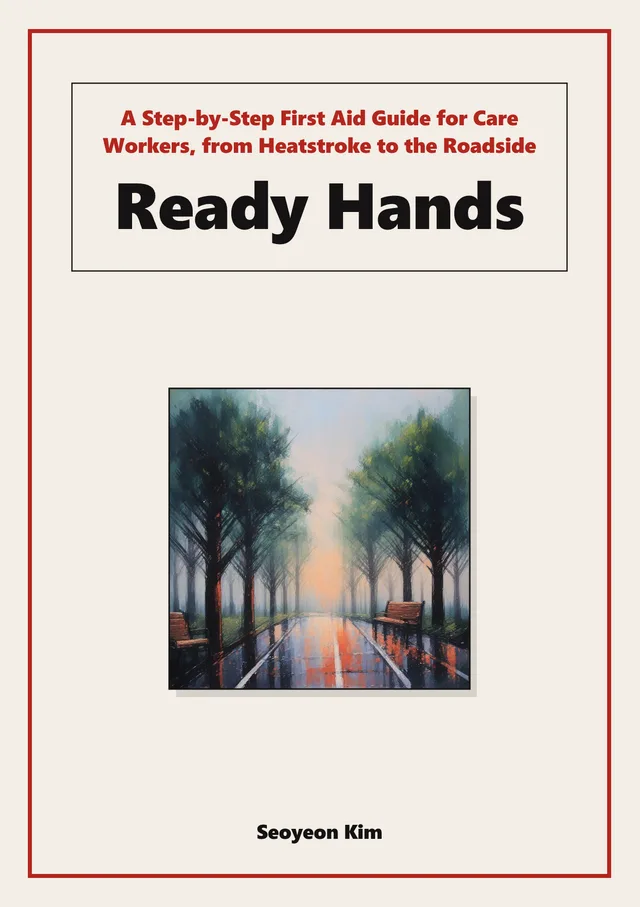
Ready Hands
$11.40 tax included
DeliveryIn your bookshelf right after purchase
Length202 pages


$11.40 tax included
DeliveryIn your bookshelf right after purchase
Length202 pages
A5 (148 × 210 mm) · 202 pages
The price, shipping and delivery time depend on the destination country (tax included).
If the book is misprinted, damaged in transit or the wrong book, please contact us within 30 days of delivery. We will reprint it and send it again free of charge. Printed books are shipped from a printer in a country near the destination. When the printer's country and the destination differ, customs duties, taxes or clearance fees may be charged on delivery and are paid by the customer.
Copies to Japan are printed in Japan by the Japanese printer 製本直送.com (Seichoku) and sent by a Japanese carrier (no customs duties; the delivery date and time cannot be chosen, and post-office pickup is not available).
The print-ready PDFs of this book (interior and cover). Print and bind one copy for yourself at home, at a print shop or with a print-on-demand service.
A5 · interior PDF and cover PDF (with bleed: two versions, 3 mm and 3.175 mm, can be downloaded.) · 202 pages
Print-ready PDF$3.50
For your own personal use only. You may print and bind it for yourself, including through a print service. You may not share, publish or sell the PDF or the printed copy. A PDF you bought stays downloadable from My books, also after your access to Trinity MemberMonthly membership ends.
Available with Trinity MemberMonthly membership. About Trinity Member
| Author | South Korea Seoyeon Kim |
|---|---|
| Category | First aid basics / Aging and caregiving / Health basics |
| Language of the book | English |
| Published | October 31, 2026 |
| Length | 202 pages |
| Product number | TB-W0008-EN |
| Reading time | About 2 h 50 min (at 230 words a minute) |
| Print-ready PDF | A5 · interior PDF and cover PDF (with bleed: two versions, 3 mm and 3.175 mm, can be downloaded.) · 202 pages |
CategoriesHealth and bodyFirst aid basics
A calm, step-by-step first aid guide for care workers — calling for help, CPR and the defibrillator, choking, bleeding, falls, burns and sudden illness — with a special focus on heatstroke and on the roads where care workers walk, drive and wait with the people they support.
See the full description of this edition
What first aid courses teach, step by step in plain words, for the people who are often first on the scene.
A man in his eighties grows confused on a hot afternoon. A woman chokes on her lunch. A car stops suddenly on the road ahead while you are walking a person home. Care workers are often the first people on the scene, at work and on the way between homes, and what they do in the first minutes matters.
This book explains, step by step and in plain words, what first aid courses teach today: making the call to the emergency number and describing where you are, checking a person who has collapsed, the recovery position, CPR and the defibrillator, choking, bleeding and shock, falls and broken bones, burns, chest pain, stroke, seizures and other sudden illness.
Heat runs through the book: how heat affects older people, how to tell heat exhaustion from heatstroke, how to cool a person fast while help is on the way and how to plan safe outings on hot days. So does the road: making an accident scene safe, hot pavements and parked cars, cold and rain. Every chapter begins with a moment from a care worker's day and ends with things to check.
After reading this book, you will be able to…
A clear, steady companion for care workers who want to be ready when it matters.
Many first aid books are written for everyone in general. This one is written for the people who support older people and people with disabilities every day, at home, in day centres and on the road. Each chapter opens with a moment they will recognise, a man who grows confused in the afternoon heat, a fall on a slippery path, a meal that suddenly stops, and then walks through what to do, one step at a time.
The steps follow the general content of first aid courses and the public guidelines they are based on: call the emergency number early, check breathing, press hard and fast in the centre of the chest, cool heatstroke fast, press firmly on serious bleeding, keep an injured person still. The book is careful to describe only current methods, and it reminds the reader again and again to follow the workplace's procedures and the person's care plan.
What makes it especially useful is its attention to heat and to the road, two places where care workers often face emergencies alone. The things to check at the end of every chapter turn the steps into daily habits, and the book warmly invites every reader to take a hands-on first aid course and keep the skills fresh.
What we like
Recommended for
Learn the emergency number where you work from official information, and take a hands-on first aid course to practise these steps.
You can buy any language edition on this page: choose it under “Language of the book” in the buy box above. Each language also has its own page.
| Delivery | Read on the web (can be saved for offline reading). Open it from My books after purchase. |
|---|---|
| Refunds and contact | For refunds and cancellations of e-books, please see these pages. 返金について · お問い合わせ · Questions and answers |