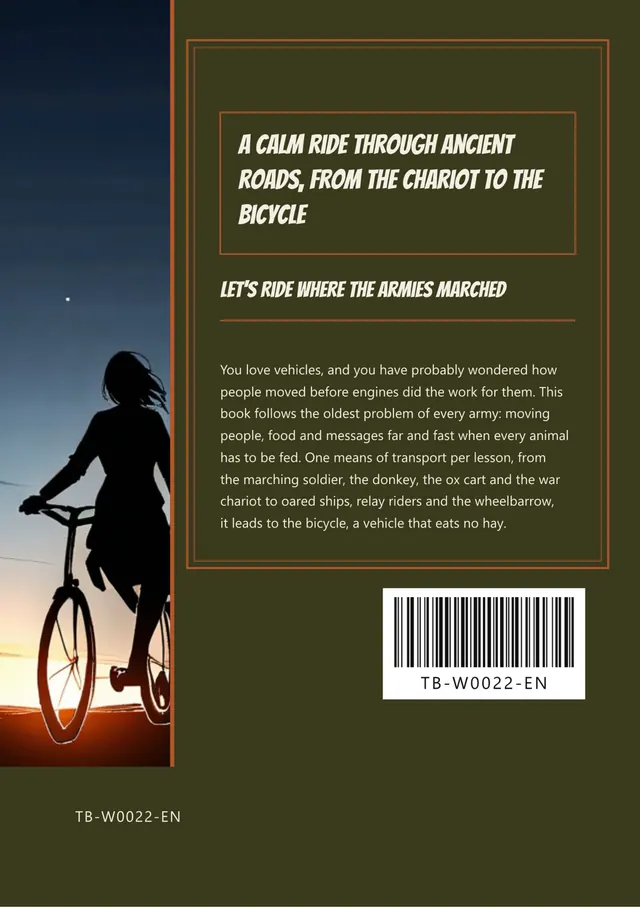
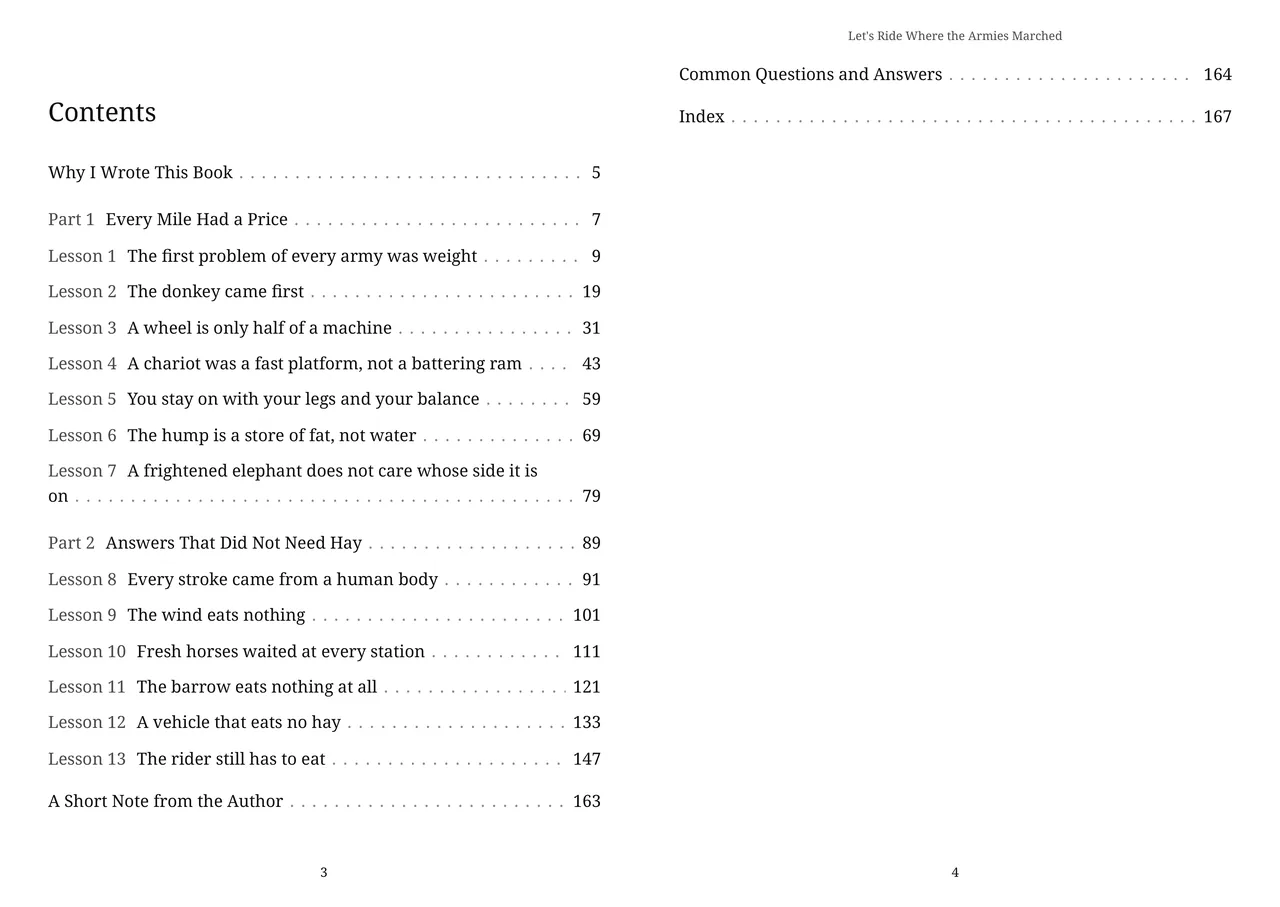
Let's Ride Where the Armies Marched

by Micah Lane

Trinity Books · November 15, 2026

A calm ride through ancient roads, from the chariot to the bicycle

Reading time: About 3 h 10 min (at 230 words a minute)

Read it in another language · 10

Read on the web (can be saved for offline reading). Open it from My books after purchase.

$11.60 tax included

DeliveryIn your bookshelf right after purchase

Length206 pages

You can choose and buy any language edition here (this page stays in your language).

Choose a format

Distributing, publishing or selling the content of a book to others makes you liable for a penalty of 2,000,000 yen under the Terms.

With Trinity MemberMonthly membership, you can also keep books you have not bought on your bookshelf. About Trinity Member

Details

AuthorUnited States Micah Lane
CategoryHistory of transportation / History of war and peace / History of inventions and technology
Language of the bookEnglish
PublishedNovember 15, 2026
Length206 pages
Product numberTB-W0022-EN
Reading timeAbout 3 h 10 min (at 230 words a minute)
Print-ready PDFA5 (148 × 210 mm) · interior PDF and cover PDF

Categories of this book

CategoriesLearning and general knowledgeHistory of transportation

CategoriesLearning and general knowledgeHistory of war and peace

CategoriesLearning and general knowledgeHistory of inventions and technology

About this book

You love vehicles, and you have probably wondered how people moved before engines did the work for them. This book follows the oldest problem of every army: moving people, food and messages far and fast when every animal has to be fed. One means of transport per lesson, from the marching soldier, the donkey, the ox cart and the war chariot to oared ships, relay riders and the wheelbarrow, it leads to the bicycle, a vehicle that eats no hay.

Everything that moves has to be fed.

Thirteen lessons take you through ancient war and transportation one vehicle at a time. You carry a soldier's pack, hold the reins of a chariot, sit on a horse with no stirrups, load a camel, pull an oar and push a one-wheeled barrow over a mountain road. In each lesson you also learn what that way of moving needed to keep going: grain, hay, water, wind or the rider's own meals.

The first part shows the problem: every ancient means of moving an army had a price in food, time and roads. The second part shows the answers people found, from ships and relay stations to the running machine of 1817 and the bicycles that armies later used for messengers and scouts. Each lesson ends by setting a few common misunderstandings straight and with a question that the following lesson answers.
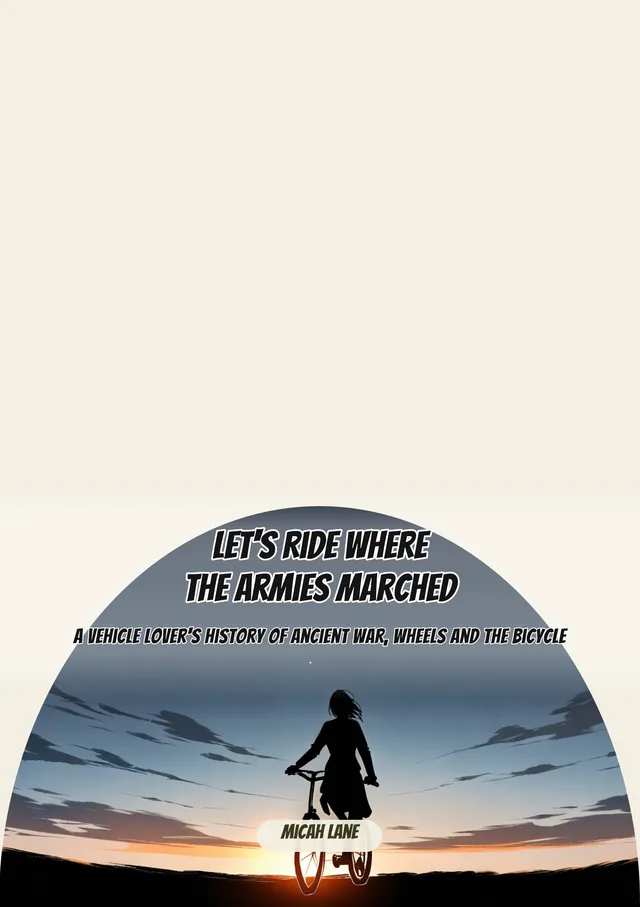

Contents

  • Let's Ride Where the Armies Marched
  • Why I Wrote This Book
  • Part 1: Every Mile Had a Price
  • Lesson 1: The first problem of every army was weight
    1. The quartermaster counts before the sun rises.
    2. A marching soldier carried much of what he needed.
    3. Everything that moves has to be fed.
    4. An army moves at the speed of its slowest part.
  • Lesson 2: The donkey came first
    1. The first great helper of armies had long ears.
    2. A donkey is built for dry and stony country.
    3. The mule joined the strength of two animals.
    4. The baggage train walked behind every army.
    5. Everything that moves has to be fed.
    6. An animal on a long trip eats part of its load.
  • Lesson 3: A wheel is only half of a machine
    1. The wheelwright joins three planks into a circle.
    2. The wheel and the axle appeared around 3500 BCE.
    3. Oxen were strong, slow and cheap to feed.
    4. Everything that moves has to be fed.
    5. A heavy cart needs a hard track.
More
  • Lesson 4: A chariot was a fast platform, not a battering ram
    1. Chariots did not smash into the enemy's lines.
    2. The spoked wheel made the light chariot possible.
    3. Two or three people rode in each car.
    4. A chariot horse needed long and careful training.
    5. Everything that moves has to be fed.
    6. A great chariot battle was fought around 1274 BCE.
    7. A young king was buried with his chariots.
    8. Chariots were also used for hunting and ceremony.
    9. The ridden horse slowly took the chariot's place.
  • Lesson 5: You stay on with your legs and your balance
    1. Riders learned to stay on with nothing under their feet.
    2. Everything that moves has to be fed.
    3. A rider who wanted to go far took more than one horse.
  • Lesson 6: The hump is a store of fat, not water
    1. Everything that moves has to be fed.
    2. Some ancient armies brought camels to war.
  • Lesson 7: A frightened elephant does not care whose side it is on
    1. The driver sat on the neck and guided the elephant with his voice.
    2. Horses that had never seen an elephant would not face one.
    3. Everything that moves has to be fed.
    4. An elephant that panics can turn on its own side.
    5. Armies learned to open lanes and let them pass.
    6. Hannibal took his elephants over high snowy mountains.
    7. Elephants were costly to catch and slow to replace.
  • Part 2: Answers That Did Not Need Hay
  • Lesson 8: Every stroke came from a human body
    1. Three levels of oars moved one long, narrow hull.
    2. The bronze ram did the fighting at the bow.
    3. Everything that moves has to be fed.
    4. Water carries weight that no road could carry.
  • Lesson 9: The wind eats nothing
    1. The wind eats nothing and never needs to rest.
    2. Big grain ships carried hundreds of tonnes.
    3. An ancient list of prices tells a clear story.
    4. Everything that moves has to be fed.
    5. A square sail pushed the ship best before the wind.
    6. Two steering oars at the stern held the course.
    7. Winter seas were avoided whenever possible.
    8. Armies near the coast could be fed from the sea.
  • Lesson 10: Fresh horses waited at every station
    1. A road of about 2,500 kilometers crossed one empire.
    2. Everything that moves has to be fed.
    3. Roads were built to move armies as well as news.
  • Lesson 11: The barrow eats nothing at all
    1. The porter balances the load instead of lifting it.
    2. Clear pictures of the barrow appear in old tombs.
    3. Old accounts speak of wooden oxen and flowing horses.
    4. Everything that moves has to be fed.
    5. Narrow paths suited a single wheel.
    6. Some lands met the barrow much later.
  • Lesson 12: A vehicle that eats no hay
    1. The drawing in the old notebook came later.
    2. Karl Drais pushed himself along with his feet.
    3. A cold summer left the horses hungry.
    4. Everything that moves has to be fed.
    5. The running machine faded within a few years.
    6. Pedals came to the front wheel in the 1860s.
    7. The front wheel grew as tall as the rider's legs allowed.
    8. Thin wire spokes hold the wheel by pulling.
    9. A chain let both wheels come down to a safe size.
    10. Air in a rubber tube made the ride smooth.
  • Lesson 13: The rider still has to eat
    1. The messenger no longer waited for a horse.
    2. Soldiers rode thousands of kilometers to test them.
    3. Whole battalions rode to the First World War.
    4. Everything that moves has to be fed.
    5. Folding bicycles came down with the parachute troops.
    6. An army rode bicycles down a long peninsula.
    7. Heavy loads were pushed along forest trails.
    8. The bicycle answers part of the oldest problem.
  • A Short Note from the Author
  • Common Questions and Answers
  • Index
  • Colophon

From the publisher

A calm ride through ancient roads, from the chariot to the bicycle

This is a history told through vehicles. Instead of kings and battles, it looks at loads, wheels, saddles, sails and the food that kept them all moving, so a reader who likes machines finds a clear thread through thousands of years.

The writing is short and plain. Dates are given with care, old stories are marked as old stories, and the many questions and answers make the book easy to read a little at a time.

What we like

  • One means of transport in each lesson, from walking soldiers to the bicycle at war
  • A short section in every lesson on what each vehicle or animal needed to eat or drink
  • Common misunderstandings, such as the camel's hump or chained galley rowers, set straight

Recommended for

  • People who love bicycles, carts, ships and every kind of vehicle
  • Readers who want to know how ancient armies really moved and were supplied

Read it in another language

You can buy any language edition on this page: choose it under “Language of the book” in the buy box above. Each language also has its own page.

Refunds and contact

DeliveryRead on the web (can be saved for offline reading). Open it from My books after purchase.
Refunds and contactFor refunds and cancellations of e-books, please see these pages. 返金について · お問い合わせ · Questions and answers