You Do Not Have to Walk Into the Clinic Alone

by Agostino Ferrini

Trinity Books · November 15, 2026

A warm, lively guide in letters that turns a frightening word into something you can understand and face with company

Reading time: About 4 h 10 min (at 230 words a minute)

Read it in another language · 10

Read on the web (can be saved for offline reading). Open it from My books after purchase.

$14.20 tax included

DeliveryIn your bookshelf right after purchase

Length252 pages

You can choose and buy any language edition here (this page stays in your language).

Choose a format

Distributing, publishing or selling the content of a book to others makes you liable for a penalty of 2,000,000 yen under the Terms.

With Trinity MemberMonthly membership, you can also keep books you have not bought on your bookshelf. About Trinity Member

Details

AuthorItaly Agostino Ferrini
CategoryBasics about illnesses / Health basics
Language of the bookEnglish
PublishedNovember 15, 2026
Length252 pages
Product numberTB-W0021-EN
Reading timeAbout 4 h 10 min (at 230 words a minute)
Print-ready PDFA5 (148 × 210 mm) · interior PDF and cover PDF

Categories of this book

CategoriesHealth and bodyBasics about illnesses

CategoriesHealth and bodyHealth basics

About this book

The appointment card has been on the fridge for three days, held up by a magnet shaped like a lemon, and the kettle has boiled twice without anyone making tea. If that kitchen feels familiar, this book was written for you. In fourteen warm letters, a friend sits down beside you and explains, in plain words, what cancer is, why it happens, how doctors find out what is going on, and what the words on a report really mean. Then he walks with you, step by step, from the first phone call to the waiting room, the questions you can ask, the days of waiting and the people you can bring along.

Fourteen letters from a friend for the weeks when cancer is on your mind.

When a worry about cancer moves into the house, it tends to take the best chair. This book answers it the way a good friend would: with a cup of tea, a lot of patience and clear explanations of how things usually work, from cells that forget the body's rules to the meaning of stage, grade and remission.

The first part explains cancer basics with everyday comparisons from kitchens, gardens, buses and post offices. The second part walks through finding your way to care: making the first call, getting ready for the first appointment, knowing who is who inside a hospital, asking questions without feeling rude, getting through the waiting, understanding treatment in broad strokes and letting people help.

Every letter stands on its own, so you can open the book at the topic that is on your mind today. Each one includes a short imagined conversation, questions you can carry into the doctor's room, and a closing section on the signs that mean it is time to see a doctor.

What you will carry away from these letters

  • A clear picture of what cancer is and why it happens, without the fog
  • The difference between a screening check and a test for a symptom
  • The meaning of the words that appear on reports and in the doctor's room
  • A calm, practical path from the first phone call to the first appointment
  • Questions to take with you, and the confidence to ask them
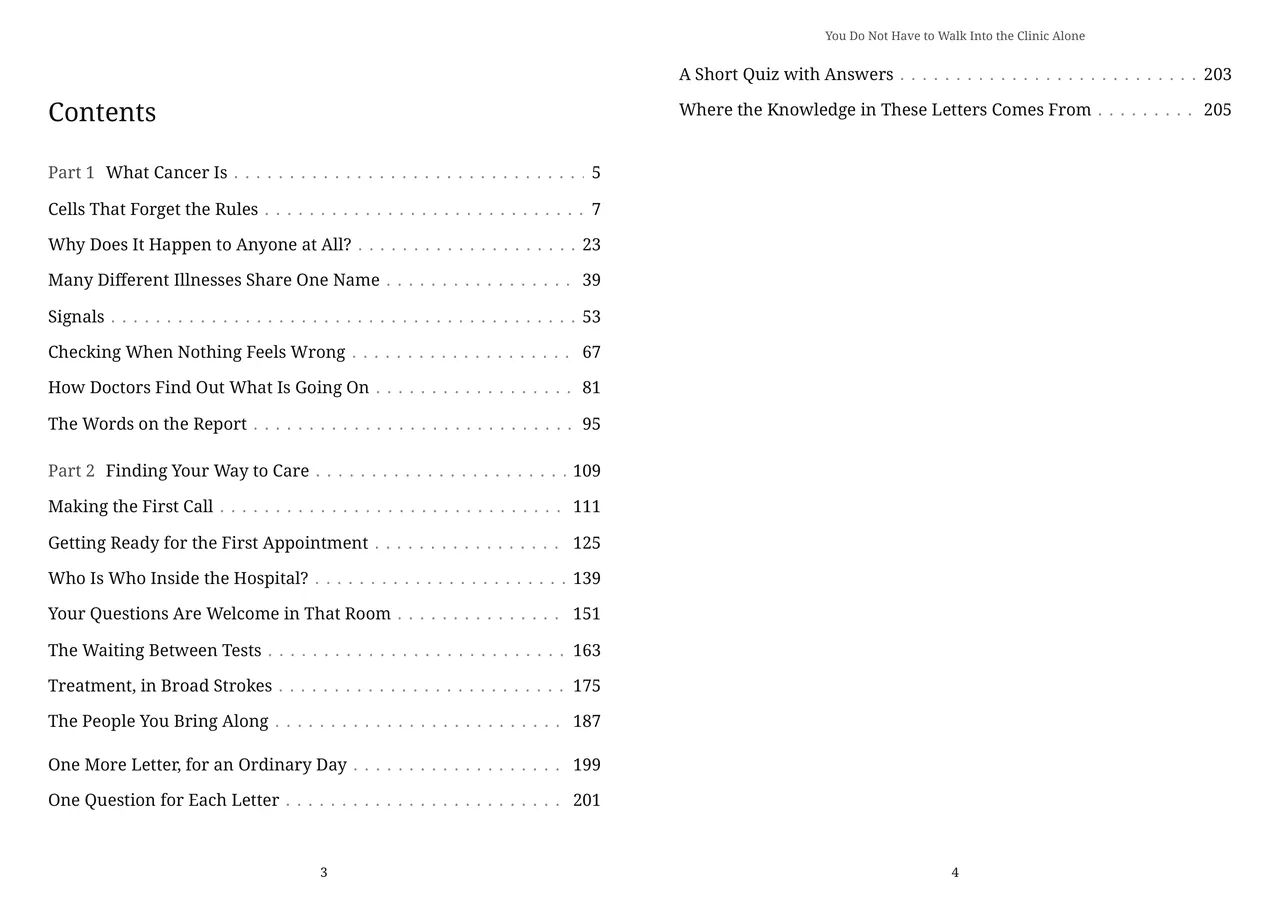
Contents

  • You Do Not Have to Walk Into the Clinic Alone
  • Part 1: What Cancer Is
  • Cells That Forget the Rules
    1. Your body is quietly rebuilding itself while you read this
    2. Every cell carries a recipe book and a list of house rules
    3. Cancer begins when a cell stops listening to the rules
    4. A Conversation I Keep Thinking About
    5. Not every lump or growth turns out to be cancer
    6. Questions to Carry Into the Room
    7. These are the moments to pick up the phone
  • Why Does It Happen to Anyone at All?
    1. Most of the story is written by time and by chance
    2. Some known things really do make cancer more likely
    3. A risk factor works like a weather forecast, not a verdict
    4. A Conversation I Keep Thinking About
    5. Blame is a heavy bag that helps nobody carry anything
    6. Questions to Carry Into the Room
    7. Your worry is reason enough to book a visit
  • Many Different Illnesses Share One Name
    1. One small word has been stretched over many illnesses
    2. A cancer keeps the name of the place where it began
    3. Some cancers form lumps while others move through the blood
    4. A Conversation I Keep Thinking About
    5. Your own story will not be a copy of anyone else's
    6. Questions to Carry Into the Room
    7. A body that keeps changing deserves a closer look
More
  • Signals
    1. Pain is a loud alarm but not a very reliable one
    2. Your body also sends quieter messages that are easy to miss
    3. Most signals have ordinary causes, and that is good news
    4. A Conversation I Keep Thinking About
    5. What matters most is a change that stays or grows
    6. Questions to Carry Into the Room
    7. Some signals should not be left waiting for another season
  • Checking When Nothing Feels Wrong
    1. Screening means looking before anything feels wrong
    2. A check for the crowd is not the same as a test for you
    3. Every sieve catches some things and lets others through
    4. A Conversation I Keep Thinking About
    5. Your invitation depends on your age, your body and your story
    6. Questions to Carry Into the Room
    7. Some changes should never wait for an invitation
  • How Doctors Find Out What Is Going On
    1. Finding out usually begins with a conversation
    2. Blood tests can point the way without giving the answer
    3. Each kind of picture shows the body from its own angle
    4. A tiny sample often gives the clearest answer
    5. A Conversation I Keep Thinking About
    6. Each step narrows the search a little further
    7. Questions to Carry Into the Room
    8. A few signs mean the testing should start sooner rather than later
  • The Words on the Report
    1. Reports are written for doctors rather than for you
    2. Benign and malignant are the two words that matter most
    3. Spread has a vocabulary all of its own
    4. Stage and grade answer two different questions
    5. A Conversation I Keep Thinking About
    6. Remission and the other words for the road after treatment
    7. Questions to Carry Into the Room
    8. Some signs need a doctor whatever the paper says
  • Part 2: Finding Your Way to Care
  • Making the First Call
    1. Being unsure is exactly the right reason to call
    2. Your family doctor or local clinic is usually the front door
    3. What you say on the phone can be short and clear
    4. A Conversation I Keep Thinking About
    5. A referral passes your story along to the right hands
    6. Questions to Carry Into the Room
    7. Certain signs mean you should pick up the phone today
  • Getting Ready for the First Appointment
    1. Your symptoms deserve a written account before the day
    2. Your medicines belong on a single tidy list
    3. Your past and your family's past both tell part of the story
    4. A Conversation I Keep Thinking About
    5. Bringing someone along can lighten the whole day
    6. The practical details on the day deserve a little thought too
    7. Questions to Carry Into the Room
    8. A few changes mean you should not wait for the booked date
  • Who Is Who Inside the Hospital?
    1. Your family doctor still holds the long story of you
    2. Specialists each look after one corner of the map
    3. Nurses and the front desk keep the whole place moving
    4. A Conversation I Keep Thinking About
    5. Some of your most important doctors work behind the scenes
    6. The team meets around one table to talk it through
    7. Questions to Carry Into the Room
    8. These are signs that it is time to book a visit
  • Your Questions Are Welcome in That Room
    1. Asking is part of the appointment, not an interruption
    2. Plain words and your own retelling clear the fog
    3. A Conversation I Keep Thinking About
    4. A notebook remembers what a nervous mind forgets
    5. Your feelings are allowed into the room as well
    6. Second opinions and consent are ordinary parts of care
    7. Questions to Carry Into the Room
    8. Some changes deserve a call to the clinic before your next visit
  • The Waiting Between Tests
    1. Waiting usually means careful work is happening somewhere
    2. Being called back for another look is very common
    3. Sometimes the first answer is simply not clear yet
    4. Questions to Carry Into the Room
    5. The days in between can be filled gently and on purpose
    6. A Conversation I Keep Thinking About
    7. Results usually arrive in a planned and careful way
    8. Some signs mean you should not wait quietly any longer
  • Treatment, in Broad Strokes
    1. Treatment is a plan built around one particular person
    2. Operations work on one place in the body
    3. Radiation is aimed carefully at a chosen area
    4. A Conversation I Keep Thinking About
    5. Some medicines travel through the whole body
    6. Questions to Carry Into the Room
    7. Some signs during treatment call for a quick phone call
  • The People You Bring Along
    1. Strength often looks like letting someone in
    2. A Conversation I Keep Thinking About
    3. A companion can steady a clinic visit without taking over
    4. Asking for help works best when the request is small and clear
    5. Questions to Carry Into the Room
    6. Helpers need looking after as well
    7. Small ordinary days are worth protecting
    8. Watch for these signs in yourself and in the people who help
  • One More Letter, for an Ordinary Day
  • One Question for Each Letter
  • A Short Quiz with Answers
  • Where the Knowledge in These Letters Comes From
  • Colophon

From the publisher

A warm, lively guide in letters that turns a frightening word into something you can understand and face with company

You Do Not Have to Walk Into the Clinic Alone reads like a stack of letters from the friend everyone wishes they had: someone who explains things patiently, never talks down, and keeps the kettle on. The tone is energetic and kind, and the comparisons come from ordinary life, so ideas like a biopsy or a tumor board feel close and understandable.

The book is honest without ever being frightening. It explains why most body signals turn out to have ordinary causes, why being called back after a check is common, and why one person's story never decides another's, while still making clear which changes deserve a doctor's eyes soon.

The second half is especially useful for anyone facing a first appointment, for themselves or for someone they love. It turns the hospital from a maze into a place with doors, people and roles, and it shows how to prepare, how to ask, and how to bring someone along.

What we like

  • Fourteen self-contained letters, each on one topic, readable in any order
  • Short imagined conversations that show real-life moments at home and in the clinic
  • A closing section in every letter on the signs that it is time to see a doctor

Recommended for

  • People who are worried about cancer and want to understand it calmly
  • Anyone preparing for a first appointment or waiting for test results
  • Family members and friends who want to go along and help well
  • Readers who prefer plain words and warm company to medical jargon

Read it in another language

You can buy any language edition on this page: choose it under “Language of the book” in the buy box above. Each language also has its own page.

Refunds and contact

DeliveryRead on the web (can be saved for offline reading). Open it from My books after purchase.
Refunds and contactFor refunds and cancellations of e-books, please see these pages. 返金について · お問い合わせ · Questions and answers